
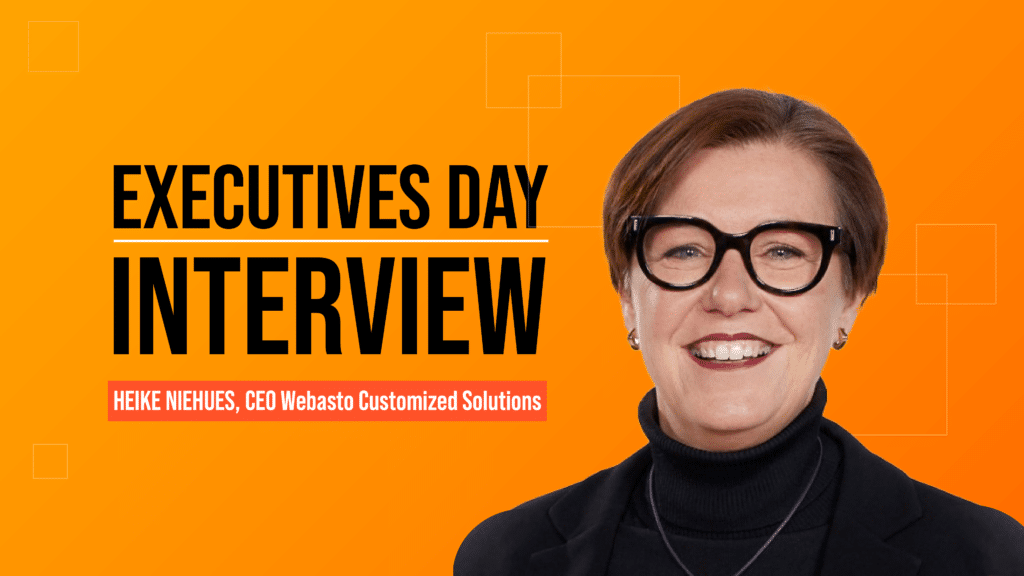
As Executive Vice President of Webasto Thermo & Comfort, Heike Niehues is responsible for all business areas of Webasto Customized Solutions (CS) worldwide. With great energy and enthusiasm, she drives the further development of CS to secure the future viability of their hardware and software products and solutions for customers. At the Executives Day (24 November 2022, Frankfurt am Main), she delivered a keynote on the subject of “The art and discipline of strategy development”.
Ms Niehues, what challenges are currently affecting your industry the most?
Heike Niehues: We have been strongly affected for some time now by the fundamental chip shortage, which creates major challenges not only in the supply chain but also for our customers. Additionally, the Ukraine crisis is causing further uncertainties that likewise affect the supply chain and our customers. These issues need to be managed and resolved jointly and successfully. Beyond that, we are of course deeply engaged in electromobility and the accompanying transformation, which we want to actively help shape – and indeed must. Here, too, every additional external influence represents a further challenge, for example in project development.
And how do you address these challenges – particularly with regard to the Ukraine crisis?
Heike Niehues: Of course, like presumably many of my colleagues, we first set up a taskforce to keep the situation under comprehensive and constant review and to be able to initiate measures at short notice at any time. This again concerns the topic of supply chain, which is essential for us, but on the other hand it also has a great deal to do with people. Throughout, we stay close to our customers and support them wherever we can. The taskforce was of great value in all of this, making us flexible and quick to react. Since the crises unfortunately continue, we have now transitioned to a longer-term mode, so we no longer have a pure taskforce but rather monitor things attentively in day-to-day business in order to take whatever action the current situation requires.
Let us turn to the topic of digitalisation. Germany is often criticised for having slept through digitalisation. What are you doing at Webasto to drive digitalisation forward?
Heike Niehues: There are several facets to digitalisation as well. One concerns the company itself, its processes and its daily operations. This starts with the internal set-up and thus the range of tools that we as employees use together with our colleagues. Naturally, digitalisation also has an enormous impact on our manufacturing. Where can we use robotics, for instance? Many initiatives are already under way, and we have already made good progress. On the other hand, all of this also affects our customer interface. How do we engage with customers? How do we deal with online ordering becoming the new standard and the customer experience in service increasingly running through digital channels? I would say we are in a good middle position there and already have some useful tools in place. But you can also see that traditional companies, or those that have been in the market for a long time, maintain very close relationships with their customers that cannot easily be transferred to a digital interface. That is an entirely different transformation than starting from scratch as a start-up. The key here is to develop viable solutions jointly with customers. What are the customers’ needs? Where can we easily bring our customers along, and where do we need to talk? Personal contact is still the more important factor there.
Now that the pandemic appears to be losing some of its terror, many employees are returning to the office. Where do you and Webasto stand on the topics of home office, new work and agility?
Heike Niehues: Home office, new work – I believe you need to combine them in the right measure. There are areas where people were already accustomed before the pandemic to working successfully in a global team with digital media and unified communications tools. In other areas, the exchange that simply happens over a coffee is, in my opinion, fundamental for working together. Here, too, we need to find a common path that is not simply either/or. I do not believe you can choose the same set-up for every function, for every department. Much of it needs to be agreed individually by the team. That also depends, for example, on how long a team has been together. If I have been working closely with others for several years, I know them and can sense in a Teams call when emotions arise that I need to address. It is different with a very young team that has just been formed, also deliberately to break new ground. In agile environments, for instance, we regularly bring new topics and teams together. There, you need at least one, if not two days a week when people meet in person. We are fairly relaxed about the environment in which that takes place. What matters is that the team comes together well to find the best possible collaboration and communication.
Where are you currently placing more emphasis at Webasto: improving structures and processes, or changing culture?
Heike Niehues: I believe you cannot do one without the other. Webasto has a very good culture. We have deeply anchored values that describe our employee interaction very well: responsibility with foresight, passion for quality and innovation, heart and mind for our customers, joy in collaboration and improvement, hands-on optimism. But we too need to develop our culture further. Over the past years, agility, home office and other aspects have naturally also changed loyalty to the company. We need to respond to that, and we do. Process and process change is my topic, and that is part of continuous improvement. If I ever stand still and say “that is the perfect process”, then in my view I have found the moment to leave this topic, because I am no longer the right person for it. I had the opportunity to speak with an older colleague – he was 65 at the time – and he said you have to question everything, turn it upside down and reinvent it every five years. That impressed me greatly, and I too attach great importance to ensuring that the continuous improvement process does not stall. So much is changing around us, including so many innovations in IT solutions, that there must be constant improvement within work processes. That is why structural and cultural change go hand in hand for me. In a company like ours, everyone must continue to develop. But I believe our values already bring us together very well.
“I very much look forward to the Executives Day – to build a new network, to look beyond the horizon of one’s own challenges and to question things that one does in daily life.”«
Why are you looking forward to the Executives Day? And why, in your view, should people definitely attend?
Heike Niehues: Firstly, I believe – and we have also observed this over recent months and years – that exchange is very important. Exchange within the industry and beyond, to discover new perspectives and solution ideas. That is why I very much look forward to the Executives Day – to help build a new network, to look beyond the horizon of one’s own challenges and to question things that one does in daily life. What I have seen so far regarding the agenda and the participants inspires me greatly. Why should you attend? I believe we need to invest much more in collaboration again. I also believe Germany can only win in the future if we move forward together much more through collaboration and partnership. Yes, we compete in many areas. But I believe we can also set a great deal in motion together and thereby make Germany attractive as a business location once more.
Let us come to the final question. Have you ever been afraid of failure during your professional career, and do you have a tip for how best to deal with it?
Heike Niehues: If it had only been once, I would have been quite the perfectionist. I believe everyone fails from time to time – and that creates experiences from which we learn in turn. I believe you have to deal with it honestly and openly. That is why I say: failure is acceptable. We all know this from studies, stories and more. Making a mistake once is acceptable. It should not happen a second time. That can only succeed if we share our experiences, exchange ideas and give each other pointers so that similar things do not happen to us in future processes and projects. How do you deal with it? For me, it comes down to talking about it, seeking new perspectives – and above all, learning from it what I can do better. Beyond that, I then need time for myself to come to terms with it. The important thing is to acknowledge what happened and then to say: “Now onwards and upwards.”

Book Recommendation

If you are looking for more stimulating ideas like those you have just read, to make your management year as exciting, satisfying and therefore successful as you wish, I recommend my recently published 55 Management Inspirations. Whether you implement them week by week or pull several levers at once: I welcome every experience report and your feedback. Best of success.
MATTHIAS KOLBUSA 55 Management Inspirations
Hardcover Published 15 December 2021
ISBN 978-3982163918 Price: EUR 19.90 / Kindle EUR 14.90 Information and ordering